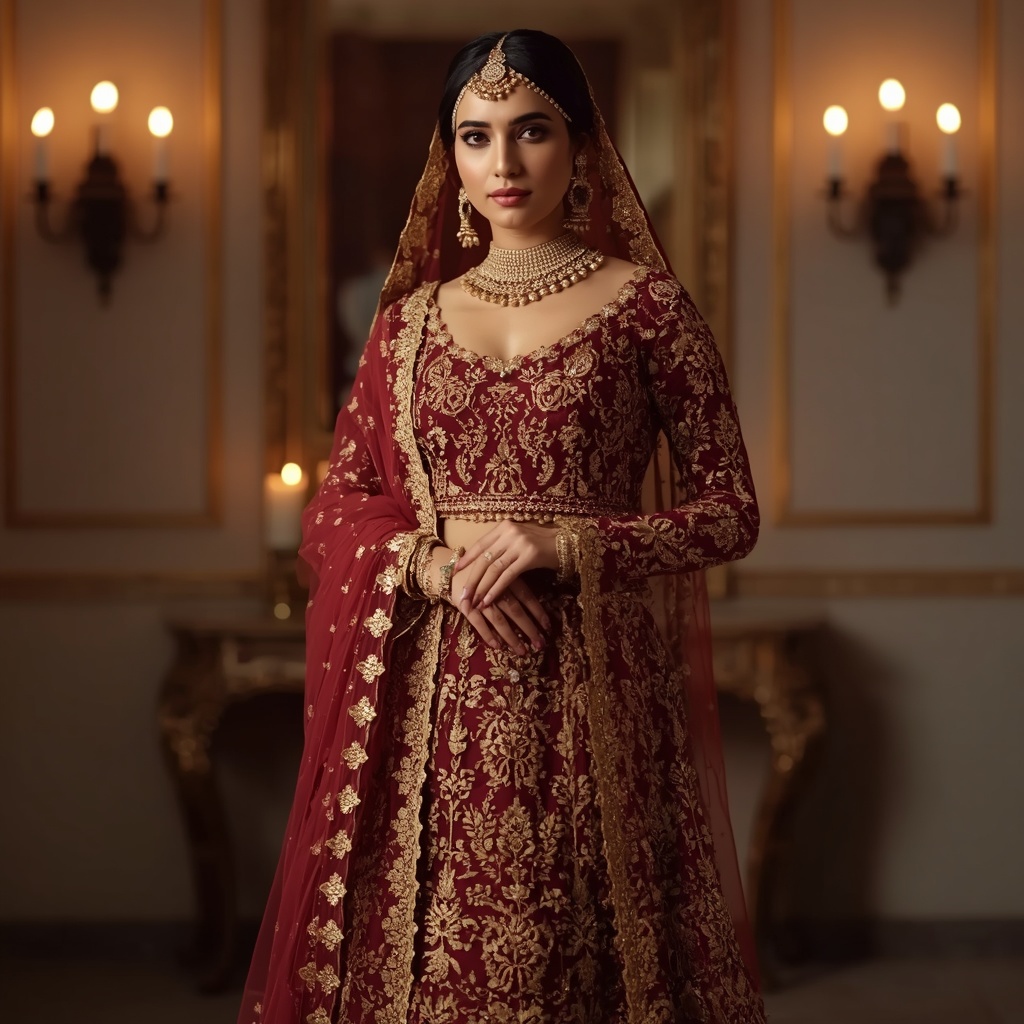
Zardozi embroidery history stretches back more than a thousand years, long before it became the signature of Pakistani bridal wear that it is today.
The word zardozi comes from Persian, zar meaning gold and dozi meaning embroidery. This form of gold embroidery is believed to have originated in Persia and Central Asia, where gold and silver thread decorated the robes of kings, courtiers, and religious leaders. It was a mark of status, reserved for those who could afford both the material and the hours of skilled labour it demanded.
Zardozi arrived in the subcontinent during the Mughal era, and it was under Mughal patronage that this embroidery reached its peak. Emperors commissioned zardozi for royal tents, horse saddles, wall hangings, and garments worn at court. Entire ateliers of karigars, the skilled artisans who practice zardozi embroidery, worked exclusively for the royal household, passing the technique down through families rather than writing it in any manual.
The technique itself has barely changed across zardozi's long history. Metal wire is coiled into tiny springs called salma, flattened into strips called kora, and combined with sequins, beads, and sometimes semi-precious stones. These elements are couched onto padded motifs by hand, so the finished embroidery sits raised above the fabric rather than flat against it. This is why zardozi catches light the way it does, and why a single dupatta can take two artisans several weeks to complete.
After the decline of Mughal patronage, zardozi embroidery did not disappear. It moved from royal courts into the hands of master craftsmen in cities like Lahore, Lucknow, and Delhi, who kept the tradition alive by adapting it for wedding wear. Bridal fashion became the new royal court, in a sense, the one occasion where families were still willing to invest in embroidery this labour intensive.
Today, zardozi embroidery is inseparable from Pakistani bridal fashion. A bride's lehenga, gharara, or gown carrying zardozi work is carrying centuries of zardozi embroidery history on her shoulders, quite literally. Machine embroidery can copy the pattern, but it cannot replicate the slight irregularity of hand work, the proof that a real person shaped every motif by hand.
At TAAR-E-ZAR, we work with karigars whose families have practiced zardozi embroidery for generations. When you choose a hand-worked zardozi piece from our collection, you are choosing a craft with a history that has survived empires.